
The envelope arrived on a Tuesday, which seemed like an unremarkable day for a miracle.
It was thin — just a single card inside, embossed with no return address. The card read: ONE ALL-ACCESS PASS. NO RESTRICTIONS. NO EXPIRATION. USE WISELY.
There was no signature. There didn’t need to be.
I already knew what I was going to do with it.
***
The Wings
I found Capa at a bar in Barcelona, which felt right. He had that look about him — camera bag slung over one shoulder, a drink already half-finished, eyes that seemed to be framing every person in the room. I slid onto the stool beside him and set the pass on the bar between us.
He looked at it for a long moment. Then he looked at me. “Where are we going?”
“Everywhere,” I said. “And some whens.”
We picked up Hemingway in Paris — he was in the middle of an argument about something, which was the natural state of him — and Errol Flynn at a hotel in Hollywood where he was causing a scandal that I won’t recount here. Flynn brought Ava Gardner, which complicated things in ways that would become apparent later.
The 1930s planes were even more magnificent than I had imagined from the YouTube footage. The Boeing 314 Clipper rose off San Francisco Bay like something dreamed up by Jules Verne, its four engines thundering, the whole craft trembling with the effort of lifting us into the Pacific sky. We rode in the wings — or as close to it as the steward would allow — watching the Golden Gate fall away behind us. The air tasted of salt and adventure. Nobody mentioned pandemics. Nobody mentioned politics. Flynn opened a beer.
The Hindenburg we rode from Frankfurt to Rio, having agreed among ourselves to avoid the New Jersey leg. The dining room was all white tablecloths and silver cutlery, the windows shaped like portholes, the whole ship swaying imperceptibly as we passed over the Atlantic. Capa took pictures constantly. Hemingway said it was the finest story he’d never write.
We were in Berlin when Jesse Owens ran the hundred meters at the ’36 Olympics. The stadium held a hundred thousand people and you could hear every one of them go quiet as he crossed the finish line. Capa’s shutter clicked and clicked. I wrote a thousand words on my portable computer that didn’t do the moment justice. Some things you can only witness.
***
The Ballparks
Ebbets Field in Brooklyn smelled of peanuts and cut grass and something ineffable that I can only call the past — not musty, not stale, but alive, like history before it knew it was history. The Dodgers were playing the Cardinals, and Dizzy Dean was pitching with that loose, almost lazy windup that somehow produced a fastball you couldn’t touch.
Frank Sinatra was in the stands, as I’d hoped. He was young — younger than I’d ever seen him — wearing a straw hat and a seersucker jacket, eating a hot dog with the focused concentration of a man who takes his pleasures seriously. I managed to get us seats three rows back. I introduced him to Flynn, which turned out to be a mistake because they immediately began plotting something. I did not introduce him to Ava.
Ava did not seem to mind. She was watching the game.
When the Dodgers went on the road, Frank and I caught the 20th Century Limited to Chicago — mostly in the club car, as God and the New York Central intended. The train swayed through the night, the Hudson and then the long flat dark of Ohio and Indiana, and Frank ordered Scotch and talked about music the way priests talk about God, with complete, unselfconscious certainty.
The Negro League All-Star Game at Comiskey Park was something else entirely. I had read about it. I thought I understood it. I did not understand it.
The baseball was faster and stranger and more improvisational than anything I had seen at Ebbets, the players performing feats that drew gasps and then laughter from a crowd that knew it was watching something extraordinary. Satchel Paige pitched three innings that seemed to bend the laws of physics. Luis Tiant Senior — the father, not the son who would later become famous — had a delivery that went somewhere between conventional and impossible, and he made it look effortless.
We found them after the game, in a bar that didn’t have a name on the door but didn’t need one. Satchel was holding court, telling a story about a game in Venezuela that grew more implausible with each telling, and nobody minded because the implausible parts were probably true. Cat Mays — just a young man then, before anyone knew what his son would become — was listening and laughing.
I bought a round and asked Satchel what it was like, playing for love of the game rather than for the money.
He gave me a look that suggested the question contained its own answer. “Son,” he said, “the money always comes later. The love has to come first. That’s true of baseball and that’s true of everything else.”
I wrote that down. Some things you get right the first time.
***
The Players
Bob Feller had hands like a farmer, which he was, or had been — grew up on an Iowa farm, taught himself to throw by pitching to his father in a pasture they turned into a diamond. He talked about the farm the way he talked about pitching, as if they were the same discipline, as if throwing a baseball ninety-some miles an hour and growing corn were both just matters of knowing the land and working with what you had.
Monte Stratton cooked us breakfast at his house in Texas and talked about his comeback after losing his leg to a hunting accident, and he was so matter-of-fact about it that you almost forgot it was a remarkable thing. “You play ball with what you’ve got,” he said, pouring coffee. “Same as anything.”
The DiMaggio brothers — Joe, Dom, and Vince — I found in San Francisco before they were famous, still the fishermen’s sons from the wharf, still young men who had bet everything on a game. Joe was already extraordinary in the way that some people are before the world catches up to what they are. He didn’t talk much. He didn’t need to.
I sat with Cool Papa Bell on the steps of a ballpark in Kansas City one evening as the sun went down and asked him if he ever resented it — the segregation, the separate leagues, the fact that he and Satchel and Luis and the rest of them had played their whole careers outside the world that would eventually anoint Willie Mays and celebrate Jackie Robinson.
He thought about it for a while. Then he said, “We played the game. That’s all anyone can do. The rest of it — that’s other people’s trouble.”
The sun was almost down. The ballpark behind us was empty and the grass had gone golden in the late light and somewhere in the distance a radio was playing something I couldn’t quite hear.
“Besides,” he said, “we had more fun.”
***
The Return
I came back on a Tuesday, which felt right. Same unremarkable day, same kitchen table, same coffee going cold in the mug beside the computer.
The pass was gone. I hadn’t noticed exactly when. It had just dissolved, I supposed, the way good things do.
My guitar was leaning against the wall in the corner. I had promised myself, at some point during the trip, that I would actually learn to play it rather than just carrying it around. There was, I had come to understand, a lesson in that. You bring the things you love. You protect them. And eventually — if you’re paying attention — you make some music.
I opened the computer and started to write.
I wrote about Capa’s shutter and Satchel’s fastball and the way the Hindenburg dining room smelled of coffee and engine oil. I wrote about the train to Chicago and Jesse Owens and the Negro League All-Star Game. I wrote about Ava Gardner watching the game at Ebbets Field with the focused attention of someone who understood that this was worth watching.
Outside, a plane went over, headed somewhere.
I didn’t look up. I already knew where it was going.
About the Author
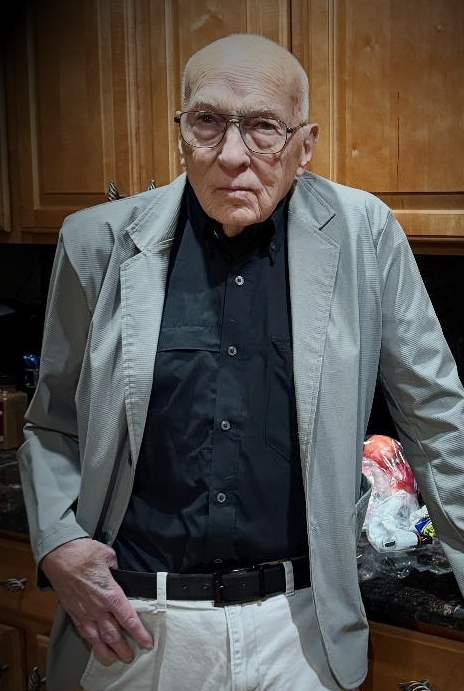 Dale Scherfling is a fulltime writer/poet and a creative writer and photographer instructor with more than 50 acceptances. He is a former newspaper sportswriter, editor and photographer and retired U.S. Navy photojournalist. His work has been accepted by The Monterey Poetry Review, San Diego Poetry Annual, Chiron Review, Mangrove Review, Letters Journal, The Blotter Magazine, 25:05 Magazine, Discretionary Love, Writing Teacher, Third Act Magazine, Yellow Mama, Close to the Bone, Flash Phantom, Dispatches Magazine, Five on the Fifth and Oddball Magazine. He is the recipient of three U.S. Army Front Page Journalism Awards and is also a college lecturer and instructor of photojournalism, photography, and music.