My life, before all this started, was a meticulous, comfortable hum. I was Ray, an office worker in my early thirties, a data analyst by trade, which meant my days were a predictable parade of spreadsheets and lukewarm coffee. My apartment was neat, my routine set, my emotions largely flatlined. I liked it that way. No surprises. No chaos.
Then came the photograph.
It surfaced during a rare fit of domesticity, a weekend spent sifting through an old box of my parents’ forgotten trinkets. They’d passed years ago, leaving me with a mountain of sentimental junk I’d never quite found the energy to go through. This box was full of faded holiday snaps, school reports, and various bits of childhood ephemera. Tucked at the very bottom, beneath a pressed flower and a lock of my baby hair, was a single, peculiar photograph.
It was an old print, slightly curled at the edges, the colours muted by time. It showed me, perhaps five or six years old, standing awkwardly in a sun-drenched park. I was wearing a ridiculous striped t-shirt and clutching a deflated balloon, a faint, almost shy smile on my face. A normal, mundane childhood snap. Except for the background.
Behind me, where lush green trees and a distant playground should have been in clear focus, stood a cluster of figures. They were profoundly, unsettlingly blurry. Not just out of focus like a poorly taken photo, but as if their very essence resisted definition. They were tall, indistinct shapes, darker than the dappled sunlight, almost like shadows given form. I couldn’t make out faces, or even distinct limbs, just a general impression of human-ish silhouettes, oddly elongated, subtly twisted. They seemed to be looking in my direction, or perhaps at me.
I frowned, a knot tightening in my stomach. I had no memory of that day, or those figures. My parents were usually meticulous with their photography; they wouldn’t have kept such a clearly flawed picture. I flipped it over. Nothing. No date, no caption. Just a blank, yellowed back.
I tossed it back into the box, a shiver running down my spine despite the warm afternoon air. It was just a badly developed photo, I told myself. An anomaly. Nothing to dwell on.
But the image had already taken root.
The first manifestation was subtle, easily dismissed. I was at work, staring at a spreadsheet that refused to balance, when I saw it—a fleeting blur in my peripheral vision, near the door of my cubicle. It was gone before I could properly register it, like a trick of the light, or perhaps just my eyes playing up from too much screen time. I rubbed my temples and went back to the numbers.
It happened again that evening, in my apartment. I was making dinner, chopping vegetables, when a tall, dark smudge flickered past the kitchen doorway. This time, it felt colder, more solid than a mere optical illusion. I froze, knife suspended mid-air. “Hello?” I called out, my voice sounding absurdly small in the sudden silence. Nothing. Just the hum of the refrigerator. My heart hammered. I told myself I was tired, stressed. Probably needed a vacation.
But the blurs persisted. They began to appear more frequently, and with a disconcerting regularity. A flicker behind a colleague in the elavator. A dark smear moving in the reflections of shop windows on my commute home. Always just out of focus, always on the edge of my vision. Like trying to catch smoke in a closed fist.
I found myself unconsciously scanning my surroundings, my gaze darting from corner to corner, my neck muscles constantly tense. My shoulders ached. Sleep became a luxury. I’d lie in bed, rigid, eyes wide open, convinced I could feel a cold spot in the room, or hear a faint, rustling whisper that sounded like dead leaves skittering across pavement. When I finally drifted off, my dreams were a jumble of indistinct shapes moving in the shadows.
One morning, I awoke with a gasp. For a split second, before my eyes fully adjusted to the pre-dawn gloom, I saw them. Two, maybe three, of the blurry figures standing at the foot of my bed, completely silent, utterly still. They were taller than a man, gaunt, impossibly dark, with vague impressions of heads tilted at unnatural angles. They just watched me. Then, as my vision sharpened, they were gone. Just the familiar furniture of my bedroom, bathed in the pale light filtering through the blinds.
The fear sharpened into a cold, hard stone in my gut. This wasn’t stress. This wasn’t tiredness. This was real.
I went back to the box, my hands trembling as I dug out the photograph. The sunlight streaming through my window seemed to mock the chilling discovery I’d made. I held the picture up, scrutinising it. My child self, smiling innocently. And behind me, the blurry figures.
But they looked…different. Or maybe it was just my imagination, amplified by fear. Were they less blurry than before? Could I discern a faint, almost skeletal outline beneath the distorted surface? It was like looking at something through a frosted pane of glass that was slowly, imperceptibly, clearing.
I tried to show the photo to my colleague, Sarah, during a lunch break. “Look at this,” I said, trying to keep my voice casual, “weird old family photo.”
She squinted at it. “Huh. Yeah, a bit blurry. Looks like your parents had shaky hands.” She handed it back, unimpressed. “Cute kid, though.”
She didn’t see it. The genuine, unsettling blur. The deliberate lack of detail that was more than just a camera defect. To her, it was just a bad photo. This isolation, this inability to share my terror, only deepened my dread.
Over the next few days, the manifestations intensified. The figures were no longer just on the periphery. They appeared directly in my line of sight, though still out of focus, their edges shimmering like heat haze. I’d walk into the living room and one would be standing by the window, a towering, indistinct mass, its non-face turned towards me. I’d blink, and it would be gone. But the sheer presence lingered, a feeling of icy cold, a palpable sense of observation.
They weren’t just watching any more. They were moving things. I’d leave my keys on the table, only to find them tucked under a cushion. A book I was reading would be found on the floor, open to a random page. Once, I came home to find every single drawer in my kitchen slightly ajar, as if someone had meticulously pulled them out just a few inches. There was no sign of forced entry, no other disturbance. Just a chilling, silent rearrangement.
My colleagues noticed my decline. I was gaunt, my eyes bloodshot, my movements jerky. I jumped at sudden noises. I snapped at people who tried to make small talk. “Ray, are you okay?” my boss asked one day, his brow furrowed. “You look like you’ve seen a ghost.”
I almost laughed, a hysterical bark that would have sounded manic. If only it were just one ghost.
I considered going to a doctor, a therapist. But how do you explain this? “Doctor, there are blurry people from an old photograph appearing in my life, rearranging my cutlery, and staring at me while I sleep.” They’d prescribe antipsychotics, and I’d end up institutionalised.
No, I was on my own.
I retreated further, becoming a recluse in my own home. I stopped going to the office, claiming a severe flu. The figures were bolder now. They would glide through rooms, their movements not quite human, a strange, fluid undulation. Sometimes, I’d see their elongated, indistinct fingers brush against a wall, leaving a faint, greasy smear that vanished when I tried to touch it.
The whispers grew louder. They weren’t words, not exactly, but a low, guttural murmur, like a swarm of insects buzzing deep inside a hollow cavity. It felt like they were trying to communicate, but in a language my mind simply couldn’t process. The sound resonated in my bones.
I spent hours poring over the photograph. I tried to clean it, to scan it, to enhance it digitally. Nothing worked. The blur was inherent, an integral part of the image, immune to technological intervention. But I could see them more clearly now, or rather, my perception of them had sharpened. I could make out the faint, terrifying suggestion of eyes—empty, dark hollows—and wide, stretched mouths that seemed to curve into a silent scream. And their hands… thin, almost skeletal, with too many joints.
The background of the photo began to shift, to blend with my reality. I’d glance at it, and the trees in the park behind my child-self would subtly morph into the familiar outline of my living room window, or the dull grey walls of my office cubicle. The illusion was fleeting, but undeniable. The park was still there, but subtly overlaid with the places I haunted. They were coming closer, not just in my present, but physically dragging my past into their monstrous truth.
One night, the fear peaked. I was sitting in my living room, the lights blazing, a frantic attempt to banish the encroaching shadows. The photo lay on the coffee table, face-up. I must have drifted off, because I woke to an unbearable cold. The air in the room was glacial, the kind of cold that seeped into your bones and froze your blood.
They were there. All around me. Not just two or three, but a multitude. They filled the room, towering over me, their blurry forms swaying gently, like kelp in a deep, dark ocean. The whispers were a deafening roar, a cacophony of non-sounds that pressed in on my skull, threatening to burst it open.
I tried to scream, but no sound escaped. My throat was constricted. I tried to move, but my limbs were paralysed. My gaze darted from one terrifying silhouette to another. They were indistinct, yes, but no longer merely out of focus. This was their true form: a terrifying, shifting opacity that hinted at unspeakable horrors beneath.
One of them, the tallest, closest one, slowly raised an arm. Its hand, though still blurry, seemed to stretch, its fingers elongating, reaching for me. I could feel the frigid air blast from it, like an arctic wind. As it moved, the true nature of the blur became apparent – it was not a photographic defect, but a veil, a shimmer of distortion that cloaked something utterly alien.
My eyes fell on the photograph on the coffee table. And then, my blood ran cold.
The child-me in the picture was no longer smiling. His face was twisted in a silent scream, his eyes wide with terror. And the blurry figures behind him in the photo… they were no longer just indistinct shapes. They were the very entities surrounding me in my living room, their forms clearer now, their terrifying, skeletal features barely masked by the distortion. They were the same, but somehow… more.
And then I saw it. Just to the left of my younger self, a new blurry figure was beginning to coalesce in the photograph. It was only a faint smudge, but I could make out its general height, its slumped posture. It was me. My current, terrified self, slowly becoming one of them.
The outstretched, blurry hand reached my face. It was impossibly cold, like touching death itself. The whispering peaked, a chorus of chilling, inhuman voices. My vision began to blur, not just the figures, but everything. The room, the photo, my own hands—it all started to waver, to lose definition, to become indistinct.
I felt myself falling, pulled not by gravity, but by some unseen force. The world around me dissolved into a featureless haze, a uniform grey. The whispers became a single, resonant drone, a sound that was both everywhere and nowhere.
And then, silence.
I don’t know how long I was there, suspended in that grey, formless void. Time had ceased to exist. All I knew was the cold, the silence, and an encroaching sense of… blurriness. My own edges blurring, my own contours dissolving.
When I finally became aware of something, it was a subtle shift. A faint glimmer of light, a distant, muffled sound. I was looking out, through a veil. Not static, not fog, but an inherent, living blur. I saw colours, vague shapes, heard muffled sounds.
A park. Sunlight. A child, holding a deflated balloon, his face innocent, smiling.
And in the background, behind him, a cluster of figures. They were tall, indistinct shapes, darker than the dappled sunlight, almost like shadows given form. They were profoundly, unsettlingly blurry.
And I was one of them, forever watching, forever waiting. My purpose, clear but unutterable, waiting for the next spark, the next focus, the next innocent face to be drawn into the eternal, chilling blur. The cycle continues. And I am just a part of the photograph now.
About the Author
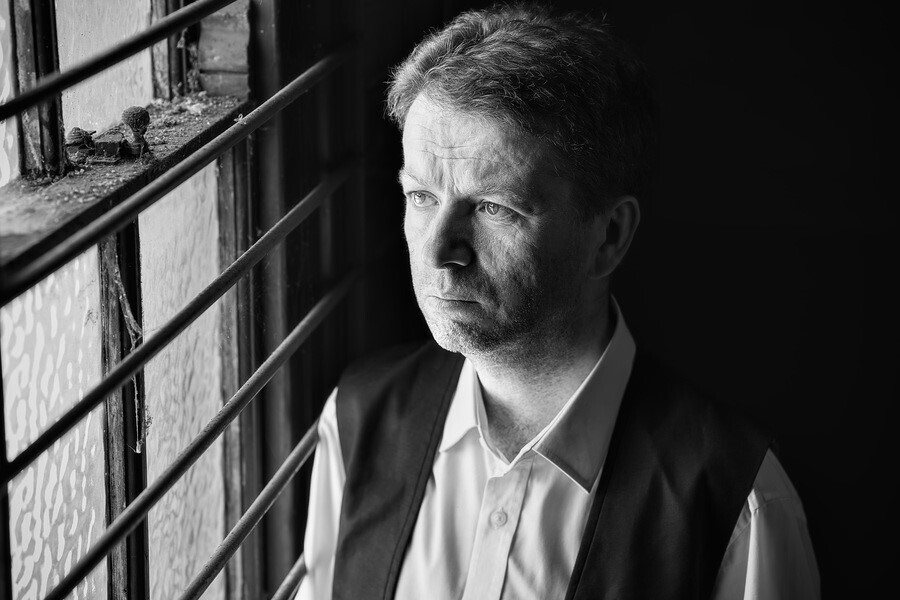 Ben Macnair is an award-winning poet, playwright and musician from Staffordshire in the United Kingdom.