Time was, when you got stuck in traffic, it was possible to blame it on something: too many people, bad urban planning, the late laws of physics. “Accidents happen,” remember? Now that true freedom is ours at last and reality is nothing if not personal, isn’t it strange that we would choose to revive the traffic jam, those eerie spectacles of self-indulgence? In making the lost experience of sitting in traffic a runaway hit, we have not only looted the past but inverted it. Now it’s your traffic jam, isn’t it Mr. Commuter-For-a-Day, your nostalgic construct and no one else’s, although the convergent overlap is said to be unprecedented. You missed them, you and all the other dinosaurs out there on the “Interstate,” that masterpiece of what have come to be called Obsolete Harmonic Mass Superstructures, or OHMS. You missed the sinking feeling of brake lights ahead, flashing their message of dashed hopes for a timely arrival down the long synapse of cars, and you missed the relief of traffic opening up again, an unsafe speed resumed.
I am not suggesting that the pinball universe was a better place, or that we should all get together and harmonically resurrect it, even if we could. But one must acknowledge a kind of phantom limb feeling of the old world, even in the most forward-thinking of us, that dizzying sense of a ground resisting the rude pressure of feet, lungs ballooning with air, hands turning wheels that guided huge, oil-burning machines ferrying flesh that was somehow us on its unimaginable errands.
That’s what’s so strange about the New Drivers. Every face in every car wears the strain of its own creation. It was never that way before. We didn’t have to cobble ourselves together out of straw and spit, fashion a harried commuter with thinning hair and high blood pressure, turning sugar into anger. Destinations were sometimes elective but rarely imaginary, and when those flesh-bearing machines collided there was no Retry or Cancel option for the involuntary participants. Unyielding surfaces, caused by the relative density of matter, combined with the laws of gravity and motion, made such events frightfully common. Our traffic accidents, orchestrated by composers using the old physics, are painstakingly detailed but essentially arid exercises in style, uninformed by the personal experience that is no longer possible for us.
Impatience, frustration, tedium: the lost coinage of time and traffic jams. Shorn of their original context, such terms are meaningless, which is no doubt part of their attraction for those of us for whom meaning and purpose are at best dated and at worst bathetic atavisms from the beast life. The glamour of limitations has proven irresistible to an alarming percentage of our nodosity, but those who believe that this fad will soon surrender to the seductions of infinite choice should remember that epochs change not in the straight, ascending line so favored by the illustrators of ancient texts, but in loops and whorls that often double back on themselves.
Every age calls itself modern, but only ours owes nothing to the past, since the past no longer exists, in fact is on its way to having never existed at all. I say ‘on its way’ because the New Drivers and their games with vanished necessities have proven that even a nullified past is available to our desires, if only in adulterated form. How could it be otherwise? The world changed, with a pitiless contempt for those physical laws we thought were unassailable. We lost and gained everything in a single cataclysmic instant, yet a mysterious residue remained, a kind of memory of memory itself, which holds the same elusive fascination that dreams are said to have had. We sift through these disconnected strands as an old man might sift through a box of broken toys from his childhood, straining to knit the fragments together in a way that might connect him to a self he can no longer imagine.
But freedom has its own terrors and pitfalls, and to punish ourselves for the occasional backward glance is ungenerous. We forget that we were one species among millions, one more ephemeral, helpless mayfly plastered to the surface of a planet whirling endlessly through space. The shelters we made out of found and synthesized materials provided only partial protection from the elements. Into the rainless rocks and shimmering deserts we wandered and multiplied, our flesh nourishing beasts and insects, and sometimes each other. We died everywhere and always, but passed our fraying memories to the next generation. For better or worse we persisted, finally thriving at the expense of the very earth that sustained us.
The Change came as a great catharsis. The world turned itself inside out, disgorging its tenants into a void without form, and the age of flesh ended. We began anew, cleansed of birth, time, need, death, endowed with nothing more than pure imagination, untrammeled joy. The self, so long exiled from the world, from others, found itself joined in great galactic clusters of selves, each both one with and separate from the whole. These vast nodosities enjoyed unlimited power of conceptual freedom, and every possible world could be simultaneously created and destroyed within imaginary dimensions of time and space. We had to adapt to a world in which inevitability, duality, tragedy, gods and heroes, laws of any kind, least of all nature, exist only as simulacra, of no more heft or moment than the turn of a kaleidoscope.
At first we suffered from this airy plenitude as our precursors had suffered gravity, though without the spur of hopes and dreams, of which we are happily incapable. The price of infinity: this absence of traction, of conflict. And as the kaleidoscope finally wearies the eye, so the appetite for fresh worlds to create and inhabit sometimes sickens into that state of fasting or withdrawal that we call sleath, during which the self node darkens to invisibility, neither emitting nor receiving light.
There are those who believe that the current fashion for traffic jams is a degraded and imperfect form of sleath, a kind of wallowing in primal forms. I would suggest a simpler explanation for the New Drivers. The Change came at a crucial moment: the apotheosis of the age of fossil fuel. How many millions of us were actually sitting in traffic when it happened?
The death of time is the death of memory, true, but those who deny the existence of even its meta-empirical traces forget that the human species did not die. It was plunged into a crucible of cosmic fire, harrowed of its essential elements and transmuted into something—we thought—as cold, airless and pure as the void in which it finds its being. But the last illusion is the illusion of purity, for trace elements of the past must have been seared into the subtlest fibers of thought. We remember it—or perhaps it is the event that remembers us—mostly as confused, synesthesic impressions of sounds, smells and colors that trouble our sleath. How can the senseless describe sensory impressions? Our only faculty of recall is imagination.
We picture ourselves as we must have been, an ordinary specimen of Homo sedentarius, encased, as it were, in concentric layers of skin, fabric, atmospheric gases and metal, stuck with thousands of other strangers in the great broken line of a traffic jam, each car inching forward a few feet and then stopping again, each a single segment of what from the air might resemble a many-colored worm several miles in length. The lifespan of this monstrous teratoid will be as brief as the highway obstruction that created it, minutes or hours at most, and its dismembering will be celebrated by each of its thousands of segments.
We are almost certainly on some sustenance-gathering errand for ourselves and our dependents when the final traffic jam occurs. We might be listening to music, or there’s someone else in the car with whom we’re commiserating over the delay, but more likely we’re alone, drumming our fingers impatiently on the steering wheel, the ache in our lower back and legs getting worse the longer we sit, helpless to do more than wait, inch forward, fidget, and wait some more. Thoughts of death, vacations, sexual fantasies, nonsense flit through the skull-hidden brain. The day is just another, sky and earth in their places, sun descending toward the horizon. The traffic stops completely for several minutes; the head nods on its stalk; we begin to doze.
The event itself seems to defy even imaginary reconstruction. One of our more literal-minded artists has chosen to represent it as a kind of Day of Judgment, with the usual stock imagery: sudden inky blackness, the stench of ozone and burning metal amidst the violent cancellation of gravity, screams that seem to come from everywhere or nowhere, as if the walls of identity have been breached and the rending shrieks filling the air are no longer anyone’s but the last despairing cry of Life itself; cracks forming in the air, the ground, the steering wheel, in our hands and faces, letting in a cold, destroying radiance as earth and sky rush together.
But visions of apocalypse are as suspect as our memories of flesh, and both come from the same impurities that survived the Change. The new reality may have happened in the blink of an eye, without warning or symptom of catastrophe, or silently and overnight, like snow. One moment we were sitting in traffic, the next…
But this is our chronic fallacy, because nothing really “happened” at all, neither the event nor our recollection of it, since both terms imply a continuity of experience, one state of being connected to another by a thread of memory that survived the change, as if we had awakened from the nightmare of life into our present condition, free to recall it at our leisure for that expanding instant we call eternity. Maybe it is less fallacy than a deep-seated wish, for we are not above the need for creation myths.
I suspect that, for better or worse, the traffic jam will continue to evolve in our imaginative cosmos, from a popular trend devoid of substance to a vital touchstone of our being, a symbol both of origin and transformation, and I have no doubt that the actual experience of sitting in traffic—in spite or perhaps because of its inaccessibility—will come at last to embody our idea of the sacred.
About the Author
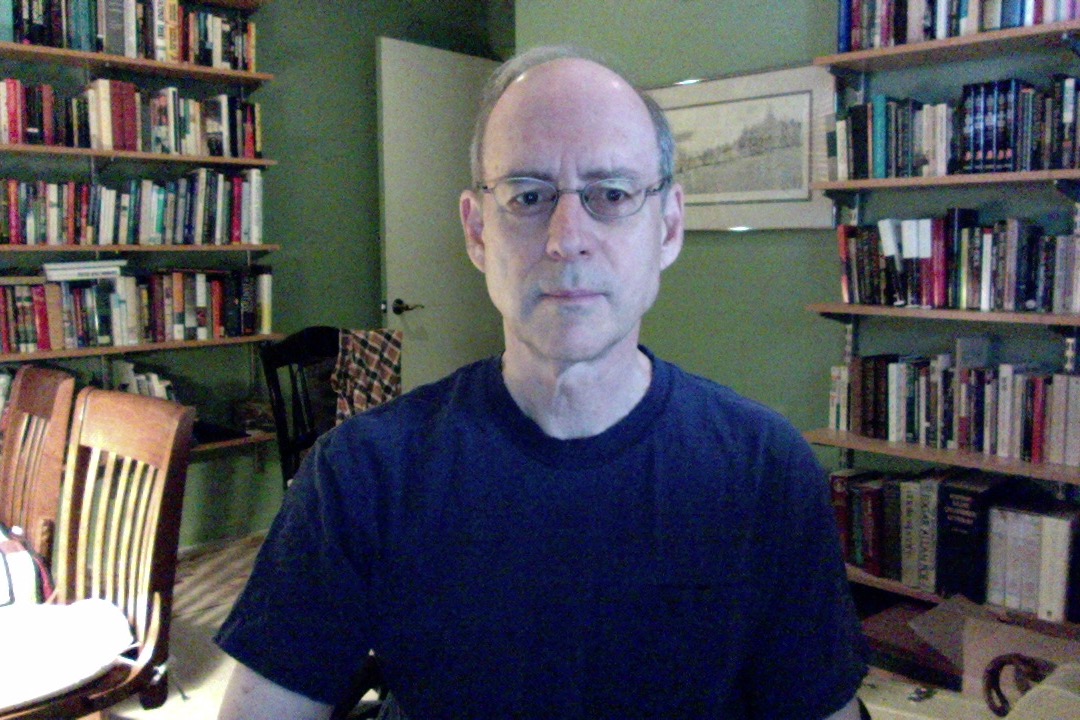 Jeffrey Greene was born in Michigan, raised in Florida, and currently lives in Bethesda, Maryland. He has been writing and publishing short stories and the occasional novella since the 1980s. Some of the publications in which his stories have appeared are the North American Review, Tomorrow Speculative Fiction, Oasis, Reactor Magazine, Potomac Review, decomP Magazine, Zahir Speculative Fiction, and most recently, Bewildering Stories.
His short story, “The Blind Gambler,” was included in the anthology,“100% Pure Florida Fiction,” in 2000, published by the University of Florida. He has self-published two collections of short stories: Stories From the Cold Room, and The Iron Desert and Other Stories.