The sterile air of the studio tasted of ozone and a faint, chemical tang, a perpetual scent that clung to Elara’s nostrils long after she’d stepped inside. Number 7B. That was the address Silas Thorne had given her. An industrial building in a forgotten corner of the city, its brick facade weathered like an old man’s face. Inside, an elevator, slow and wheezing, carried her to the seventh floor, depositing her in a sparsely lit corridor that echoed her footsteps. The door to Studio 7B was a plain slab of metal, unmarked save for a small, embossed number.
Elara adjusted the strap of her bag on her shoulder, a nervous flutter in her stomach. This was it. Her big break, potentially. Silas Thorne was a name whispered with reverence in certain fashion circles, a reclusive artist known for his stark, unsettling portraits. A friend of a friend had pulled strings, gushing about his eye for raw emotion, his ability to “see beneath the skin.” Elara, fresh out of her small town and hungry for a career, had jumped at the chance.
She knocked. The sound seemed to vanish into the thick silence behind the door. After a moment, it slid open, revealing Silas Thorne.
He was less imposing than she’d imagined, but no less unsettling. Tall and lean, with a gaunt face framed by lank, dark hair that swept across his brow. His eyes, though, were a shock – a startling, icy blue, set deep beneath heavy brows, that seemed to bore into her. Not in a predatory way, not immediately, but with a gaze so acutely perceptive it felt like being X-rayed.
“Elara,” he said, his voice a low, gravelly murmur. “Come in.”
The studio was vast, almost cavernous. A high ceiling, painted a dull charcoal, was crisscrossed with tracks for lights and diffusers. The main shooting area was a pristine white cyclorama, curving seamlessly from floor to wall, bathed in the cool, even glow of professional strobes. Cords snaked across the polished concrete floor like sleeping serpents. To one side, a cluttered desk bristled with monitors and camera equipment. To the other, a changing screen stood guard over a rail of clothes.
“Make yourself comfortable,” Silas gestured vaguely towards a worn leather armchair by the desk. “We’ll start in a moment. Just finishing up some technical adjustments.”
Elara sat, placing her bag carefully beside her. The air in here felt heavier than outside, almost stagnant, despite the ventilation system humming faintly overhead. Silas turned his back to her, fiddling with a camera mounted on a tripod, occasionally muttering to himself. His movements were precise, almost ritualistic.
She watched him, trying to quell the rising tide of unease. He hadn’t smiled, not once. His face remained a mask of intense concentration. She told herself it was artistic temperament, a sign of his dedication. She’d heard stories about eccentric photographers. This was probably just… his way.
After what felt like an eternity, he turned, the camera now slung around his neck. “Ready, Elara?”
Her mouth felt dry. “Yes, Mr. Thorne.”
“Silas, please,” he corrected, his gaze still fixed on her. “I believe in a collaborative process. And for that, we need trust.” His lips barely moved when he spoke.
He led her to the changing screen. “I’ve picked out a few pieces. Simple, minimalist. I want to focus on you.”
The clothes were indeed simple: a plain black slip dress, a white cotton shift, a pair of dark trousers and a camisole. Nothing striking, nothing to distract. As she changed, Elara found her eyes drawn to the studio’s periphery. Odd details emerged from the industrial starkness. A dusty, antique vanity mirror leaned against a far wall, its silvered surface cloudy with age. A collection of taxidermied birds – owls and crows – perched on high shelves, their glass eyes seeming to follow her. And in a shadowed corner, a tall, slender mannequin, draped in a sheet, stood perfectly still. Its covered form somehow more unsettling than if it had been exposed.
She emerged, feeling vulnerable in the black slip. Silas nodded, a flicker of something unreadable in his eyes.
“Excellent. Come, stand on the mark.” He pointed to a small cross taped to the white floor.
The shoot began. Silas moved with a quiet efficiency, adjusting lights, barking terse instructions. “Chin up. Relax your shoulders. Look directly into the lens. Good.”
Elara tried to channel every pose she’d practiced, every emotion she’d been taught to convey. She shifted, angled, softened her gaze, sharpened it. The relentless click-whirr of the camera shutter became the rhythmic pulse of the room.
Silas, however, wasn’t satisfied with simple beauty shots. His instructions grew stranger.
“Now, Elara… imagine you’ve just seen something… truly terrible. Something that cannot be unseen. Let that fear bloom in your eyes.”
Elara furrowed her brow, trying to conjure genuine horror, drawing on past anxieties, old nightmares. She posed, holding her breath, her eyes wide.
“Good. Very good,” Silas murmured, snapping furiously. “Now, a touch of desperation. As if you’re trying to escape something that binds you. Something invisible, but utterly inescapable.”
He had her twist her body, arch her back as if struggling against unseen bonds, her hands reaching out, grasping at empty air. Her muscles began to ache. The poses felt less like modeling and more like a performance of distress.
“Perfect! Hold that, Elara. The terror… the despair.”
His words, spoken in that low, even tone, sent a shiver down her spine. It wasn’t just the words; it was the way his eyes lit up, not with excitement, but with a cold, almost predatory satisfaction, when she hit the mark he sought.
During a brief break, while Silas reviewed his shots on a monitor, Elara slipped off to the small, gender-neutral bathroom. She splashed cold water on her face, heart thumping. It’s just acting, she told herself, staring at her reflection. It’s what he does. He captures emotion. But the face staring back was pale, a little too strained. She looked… haunted.
When she came back, Silas was waiting for her, a faint smile playing on his lips – the first she’d seen. It did little to ease her discomfort.
“I think we’re ready for the next phase,” he announced. “I have a specific concept. It requires… a certain vulnerability.”
He brought out a prop: a simple, wooden chair, old and dark, almost black with age. It looked out of place against the gleaming white cyclorama.
“Sit,” he instructed, placing it in the center. “No, not like that. Turn it around. Straddle it. Face the backrest.”
Elara did as she was told, feeling awkward, exposed.
“Now,” Silas continued, his voice dropping an octave, “rest your arms on the backrest. Lean into it. And lower your head. Look up at me from beneath your brows. As if you are trapped. As if you are watching something from a cage.”
She felt the cool, smooth wood against her cheek. The pose felt intimate, oddly submissive. She tried to project defiance, but Silas quickly corrected her.
“No, Elara. Not defiance. Acceptance. The acceptance of your fate. The understanding that there is no escape. Let me see the quiet dread of resignation.”
It was harder than she thought, to conjure such a specific, chilling emotion. But something in Silas’s relentless gaze spurred her on. She tried to empty her mind of everything but the instruction, to feel the weight of an imagined, inescapable dread.
As she held the pose, a strange thing happened. The studio lights, usually so steady, flickered. Just for a second. The hum of the ventilation system seemed to stutter. And then, from the edges of her vision, a movement. A whisper, like dry leaves rustling across the polished concrete floor.
Elara tensed, her eyes darting towards the corner where the draped mannequin stood. Had its sheet shifted? Or was it just a trick of the straining light?
“Hold still, Elara,” Silas’s voice cut through the silence, sharp, like a surgeon’s scalpel. “Don’t break the moment.”
She froze, forcing herself to breathe slowly. The air grew colder, she was sure of it, despite the warmth of the studio lights. A prickle of gooseflesh rose on her arms.
It’s nothing, she told herself. Just tired. Nerves. Long day.
But the feeling persisted. A sense of being watched, not just by Silas and his camera, but by something else, something unseen, lurking just beyond the glare. The glass eyes of the taxidermied birds seemed to glint with an unnatural awareness. The antique mirror, far in the shadows, looked deeper, darker, like a void.
Silas was changing lenses, his back to her for a moment. Elara risked a quick glance over her shoulder. The mannequin was exactly as it had been, still, swathed. The corner was empty. She exhaled slowly.
“Good,” Silas said, turning back, his camera raised. “Now, Elara, look at me. But don’t see me. See past me. See into the void. See the absolute, crushing emptiness. Let your eyes be windows to nothingness.”
He kept talking, guiding her deeper into the abyss of his vision. He wanted her to look like a shell, an empty vessel. He wanted the fear, the despair, the resignation, to drain away, leaving only… absence.
The session stretched on. Elara felt herself growing numb. Her limbs ached, her mind was a fog of forced emotions. Every fiber of her being screamed for a break, for a moment of silence without the relentless click-whirr. But Silas was relentless, his energy unwavering.
“One last set,” he announced, his voice holding a note of intense, almost feverish anticipation. He moved the old wooden chair, pushing it aside.
“Lie down, Elara,” he instructed. “On the floor, here.” He gestured to the pristine white cyclorama. “On your back. Arms at your sides. Like… sleep. No, not sleep. Something deeper.”
He paused, his eyes narrowing. “Imagine… you are no longer here. Your body is here, but you have left. A shell. That’s what I want. The beauty of the vacated form.”
Elara lay down. The floor was cool against her back. She closed her eyes for a moment, trying to gather herself. But Silas’s voice cut in again.
“No, eyes open, Elara. Stare directly up. Unblinking. Let them reflect… emptiness. The ultimate surrender.”
She opened her eyes. The bright, artificial lights above hurt. She focused on the largest softbox, a rectangle of white light, until it blurred. She tried to make her face blank, her features still.
And then, just above the softbox, a shadow. Not a normal shadow, but a shape, dark and indistinct, that seemed to press against the light, distorting its edges. It pulsed faintly, like a vast, unseen heart.
Elara’s breath hitched. She wanted to move, to sit up, to scream. But she was frozen, pinned by Silas’s instructions, by the strange, icy cold that had settled on her.
“Excellent,” Silas breathed, his voice closer now. He was directly over her, the lens of his camera a gaping, black eye just inches from her face. “Yes, that’s it. The stillness. The… absence.”
The shadow above the light grew bolder, bleeding into the white. It seemed to have tendrils, reaching down. Elara could almost smell something – stale dust, something metallic, and something else, something utterly alien and foul, like forgotten decay.
“They’re almost here,” Silas whispered, his voice almost a hiss, the words meant for himself, not her.
Her eyes, unblinking, suddenly focused not on the light, but on Silas. His face, illuminated by the harsh strobes, seemed to shift. The skin around his eyes was stretched taut, his pupils dilated to swallow the icy blue. There was a faint, almost imperceptible tremor in his hands, but his gaze was locked on her, incandescent.
And behind him, reflected faintly in the lens of the camera, Elara saw it. A distortion in the air, a shimmering, indistinct form, like heat haze but colder, darker. It was vast, formless, yet possessed a terrible weight. It pressed in, filling the spaces, clinging to the shadows. It was the source of the cold, the decay. It was the unseen presence.
This isn’t about art, a terrified thought screamed in Elara’s mind. It’s about something else. Something utterly wrong.
Silas clicked the shutter button again and again, a frantic, almost desperate rhythm. The camera wasn’t just capturing her image; it felt like it was tearing something out of her. A piece of her soul, her essence, her very will.
The shadow above the light detached, drifting closer, resolving into something faintly humanoid but grotesque, limbless, featureless, just a void of darker shadow. Beside it, another, and another. They were gathering, drawn by something. Drawn by her.
Elara felt a scream rising in her throat, but it was trapped. Her body was rigid, paralyzed by a terror so profound it stole her breath. Her eyes were still open, still staring blankly.
“Almost there,” Silas murmured, his voice laced with triumph. “Just a little more… Emptiness. Yes. Let it take you.”
He was not photographing her. He was offering her.
Desperate, Elara tried to move a finger, a toe, anything. Her muscles screamed in protest, but she forced a twitch. A small, almost imperceptible tremor ran through her body.
Silas paused. The triumphant light in his eyes dulled, replaced by a flicker of annoyance, then a chilling resolve. “No, Elara. You must remain still. Completely still.”
He reached out a hand, not to calm her, but to press firmly against her forehead. His touch was cold, clammy. As his fingers made contact, an agonizing pressure bloomed in her head, spreading outwards, pressing down on her thoughts. Her vision blurred, the shadows above the light coalescing, sharpening. She saw faces, or what passed for them – gaping, hollow, hungry. They were not human. They were ancient, predatory, drawn by the emotional vacuum Silas was creating within her.
And Silas, beneath his skin, seemed to hum with an unnatural energy. His eyes were no longer merely deep blue; they swirled with an infernal light, reflecting the growing presence of the entities in the room. He was not just a photographer; he was a gatekeeper, a summoner. His camera, a conduit.
“The perfect canvas requires a perfect void,” he whispered, his voice resonating with an unholy echo. “And you, my dear Elara, are almost perfect.”
The click of the shutter was impossibly loud now, a thunderclap in her skull. Each flash felt like a blow, chipping away at her resistance. She could feel something being pulled from her, an invisible thread stretching taut, about to snap. Her very self was unraveling.
Just as the last vestiges of her will threatened to crumble, a sudden, jarring sound. A distant siren, wailing into the desolation of the industrial park. Faint, but undeniable.
The shadows overhead recoiled, a collective intake of a breathless gasp. Silas’s grip on her forehead faltered. His eyes snapped upwards, away from Elara, a frustrated snarl twisting his lips. He cursed under his breath, a word in a language Elara had never heard, sharp and guttural.
The siren faded as quickly as it had come, but the moment was broken. The entities, previously so bold, seemed to shrink back, their forms shimmering, dissolving into the deeper shadows of the studio. The oppressive cold lessened, the smell of decay receded slightly.
Silas slowly lowered his hand from Elara’s forehead. The incandescent glow in his eyes faded, replaced by that keen, unsettling blue. His face was pale, drawn, a mask of cold fury.
“The moment is lost,” he said, his voice flat, devoid of the earlier triumph. He stared at her, not with hunger now, but with intense disappointment, a sculptor whose clay had spoiled.
Elara, released from her silent paralysis, gasped for air, a ragged, choking sound. She pushed herself up, scrambling backward on the pristine white floor, away from him, away from the tripod, away from the camera that felt like a weapon.
Silas watched her, unmoving, his gaze like ice. He didn’t try to stop her.
“You’re… you’re dismissed,” he said, the words cutting through the air like shards of glass. “The session is over. I have what I need.” His eyes flickered towards the camera.
Elara didn’t wait for another word. She stumbled to her feet, her legs trembling, and half-ran, half-crawled towards her bag, snatching it up. She didn’t look back. The mannequin, the taxidermied birds, the antique mirror – they all seemed to watch her frantic escape.
The dressing screen was a blur. She ripped off the black slip, pulling on her own clothes with trembling fingers. Her mind was a chaotic storm of terror and disbelief. What had she seen? What had almost happened?
She burst out of the screen, her eyes darting towards the door. Silas was still by his camera, his back to her now, meticulously unmounting the lens. He seemed utterly calm. Too calm.
Without a sound, Elara fled. She fumbled with the metal door, yanking it open. The dimly lit corridor outside felt like a haven. She slammed the door behind her, leaning against it, gasping for breath, the metallic taste of fear coating her tongue.
The creaking elevator took forever to arrive. As she descended, she closed her eyes, trying to purge the images from her mind: the shifting shadows, the monstrous faces, Silas’s inhuman eyes.
She burst out of the building into the cool evening air, the city lights a welcome, grounding presence. She didn’t stop running until she reached the nearest bus stop, her chest heaving.
Later, much later, huddled in her small, cheap apartment, the memory of what had happened felt like a nightmare, too vivid to be real, too horrifying to be mere illusion. She kept telling herself it had to be exhaustion, overactive imagination, a trick of the lights.
But then, an email pinged on her phone. From Silas Thorne. A single attachment.
Her heart leaped into her throat. With shaking hands, she opened it.
It was a photograph. Of her. From the last set. Lying on the white cyclorama. Her eyes were wide, unblinking, staring blankly upwards. Her face was pale, utterly devoid of emotion, a perfect mask of stillness.
But it wasn’t just her.
Reflected faintly in the depths of her vacant eyes, like tiny, distorted pearls, were the blurred, indistinct forms of the shadows. And just above her, caught in the stark light above her head, the unmistakable, gaping void of a monstrous, hungry face, gazing down at her.
And in the very center of her pupils, two pinpricks of light: the cold, calculating reflections of Silas Thorne’s triumphant, burning eyes.
She stared, unmoving, at the image on her screen. He had said, “I have what I need.” He had captured it. Not just her image, but the moment. The presence. He had taken her horror, her vulnerability, her very essence, and made it a window. A gateway.
Elara felt a cold dread seep into her bones, solidifying into a terrible certainty. She was not just a model in that photograph. She was a conduit. And Silas Thorne had not just taken her picture. He had opened a door, and he was still holding the key. And now, so was she. The click of the shutter echoed in her mind, a perpetual whirr.
-Ends-
About the Author
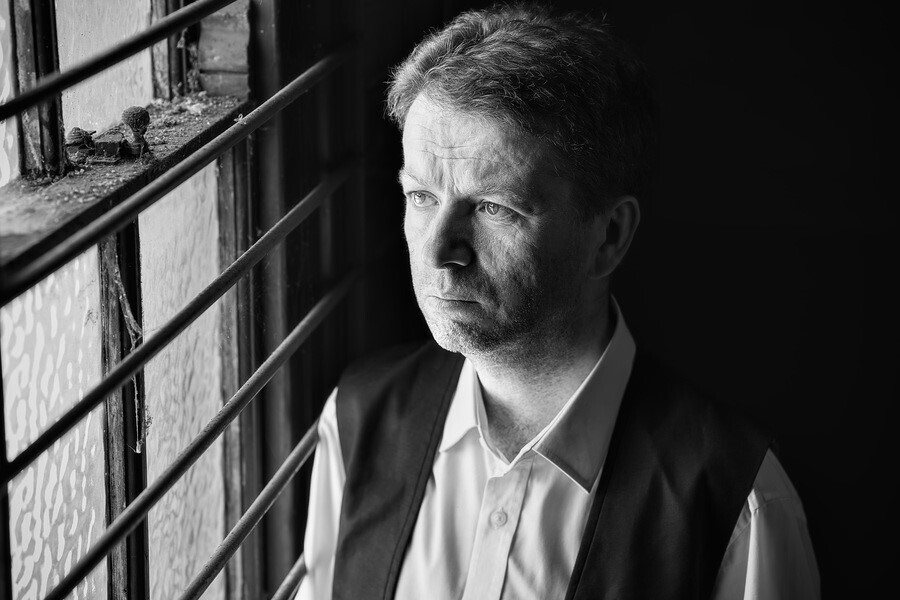 Ben Macnair is an award-winning poet, playwright and musician from Staffordshire in the United Kingdom.